a room of your own
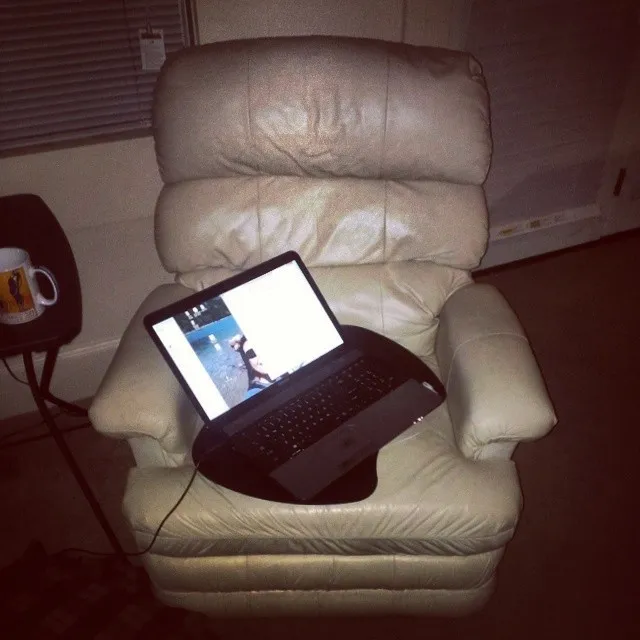
My office. For tonight, anyway.
in the first entry, i discussed finding your fertile crescent. in the last entry, i talked about my idea file. in this entry i talk about finding a room of your own. creating a working environment that’s conducive to your writing habit.
those who write stories must learn the value of a perfect setting. think for a minute about how you choose the setting for a scene. what does that particular setting need to do? what exactly needs to be done in that setting? how much description of the setting should you include?
setting, i’ve found with my beginning screenwriting students, can often be an afterthought or a general misunderstanding of formal structure. one of the more common symptoms of this phenomenon that is evident in the writing is the ubiquitous café scene. too much good talk has been wasted over stale coffee and re-hashed browns that have been hashed over and over again, and in better films than you or i are ever likely to write.
set your dialogue (and your action) elsewhere. and not just any old where. some where.
to choose a café as a location for your characters to chit-chat is more than likely the result of literary laziness of the worst kind: disunity. plot unity is an important formal element of film stories. your choices for moments of disunity should be just that, a deliberate choice to introduce a wrinkle or cliché. so that it can delay the resolution, frustrate it, or so that it can be subverted, parodied, or exploded.
a unified plot is, in simple story terms, a plot that adheres to “aristotle’s dramatic unities.” note my placement of the quotation marks. these are not principles that aristotle referred to as his “dramatic unities,” or, in other words, aristotle’s “dramatic unities.” no, here the quotation marks are “scare quotes,” which i’ve here also put inside “scare quotes.”
and not the kind of scare quotes where the meaning turns out to be some unities of aristotle’s that everyone thinks are very dramatic. that would be aristotle’s “dramatic” unities.
you know. dramatical. like, “unify your plots or i’m going to set myself on fire!”
the dramatic unities are principles that are actually only very loosely associated with aristotle and what he had to say about the drama of his time in his poetics. the illumination and adaptation of aristotle over time has resulted in his attribution for things that never actually appeared in his text. dialogue has been forced into his mouth. aristotle never himself referred to the “dramatic unities,” but instead only “dramatic unity.” The concept of dramatic unity is explained by ucla screenwriting program graduate and author, michael tierno’s handy application of aristotelian literary principles to screenwriting, aristotle’s poetics for screenwriters: storytelling secrets from the greatest mind in western civilization.
based on what aristotle did have to say in his poetics, the inferences made by the nameless medieval scribes and named neoclassical scholars who have perpetuated and elaborated aristotelian literary theory have resulted in two additional dramatic unities. that makes a grand total of three aristotelian rules of drama: the unity of action, the unity of place, and the unity of time.
the additional two principles sound very similarly (verisimilarly) to his words; the dialogue written for aristotle seems organic. this should be your goal for dialogue, too, writing “seemingly organic” dialogue, not realistic dialogue but instead verisimilar dialogue. that is, however, a whole ’nother set of scare quotes.
the immediate question is, what’s your goal for setting? your goal should be to set your scenes in locations that exhibit a unity of place. for ancient plays, this might have meant to confine the action of the drama to a single important location, without compressing geographic space. in modern screenwriting, that way of thinking about the unity of place is generally too confining and not at all accurately descriptive of the majority of film narratives. instead, for writing today, the unity of place can be adapted to mean a recognition evident in the writing that what the characters do, act, and say is irreversibly linked with where they do it.
this link might be the result of a homophonic match, in which the setting and what the characters do in it work to support and sustain one another. the significance of the location in this case is built on appropriateness to one another, verimilitude. the extreme case of this is an integration such that the action and dialogue set in a particular location couldn’t possibly happen anywhere else.
the significance in polyphonic matching of location and character acts and speech works based on difference and tension. in extreme cases, the acts and speech shouldn’t even be taking place in the setting chosen for them. inappropriateness is de rigeur in polyphonic matching of setting with characters and those characters’ happenings.
(students who’ve had my media aesthetics course may remember the terms homophonic and polyphonic used also when referring to the matching of image and sound. that same distinction has here been appropriated.)
there is a whole gamut of setting choices that ranges between the two extremes.
another setting question with which you must concern yourself is the question of Bestimmtheit, a term that, in literature, refers to the question of determinacy, or specification of detail. on other words, “how much detail do i provide?”
but wait. we’re here to talk about a specific setting outside the fiction. the setting in which you write. your working environs. see, i told you in my first entry that digression is my greatest asset.
anyway, you must have a writing space of your own. or, preferably, several of them. tonight’s instragram photo shows the “office” i “retire to” once i’ve had it with the desk in my home office, but before i end up with my laptop and accoutrements sprawled out in my “floor office.”
next time, we’ll try to manicure these landscape discussions down to a pair of manageable lawns: one a setting in which to work, the other a setting within your work. finish up brande this week and begin tierno.