more on setting your writing and on writing your settings
setting is not just about place, although that’s certainly important to it. setting, as it’s translated and manipulated into screen space, helps your viewer to construct a mental map that they will use to make spatial sense of the film. however, setting is important in other ways, too. setting conveys mood, partly as a result of the selection of place, but also in terms of that place’s ambiance. as i mentioned last week, the choice of setting can work with the characters you place in that setting or against them. that matching of setting and characters, their speech and actions, creates a mood and a particular modal treatment of the material of the story. the relation between character and setting can create comedy, can frighten, can create suspense, or sadness.
so setting is not just a place, but a complex interaction of visual and audio elements that work together to contain the action and dialogue. in terms of audio, ambient sounds, quality of vocal sound as lines are delivered, dynamics, diegetic music, etc. will all affect the film’s setting. but, just how many of these do you, as screenwriter, really have control over in a film, and how much should you include in the script? how much visual material should you describe, for that matter? we’re back to a question I introduced last week, the question of Bestimmtheit, the question of determinacy, or specification of detail. the question, “how much detail do i provide?”
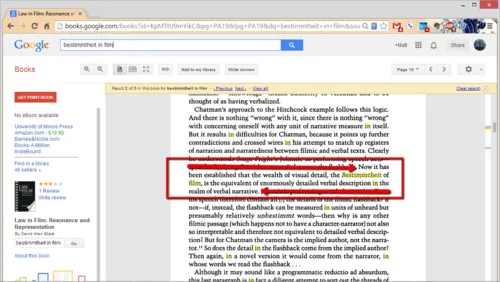
the answer to this question is simple and straightforward, “as much detail as is necessary and relevant to the story.” these two criteria are the two against which you should evaluate everything you consider including in your script. comedy writers, note: there are exceptions to these two criteria for your particular genre, producing a particular kind of non-sequitur humor.
these criteria have less to do with storytelling than with the particular medium of the screenplay and the historical production processes of film. what you are producing when you write a screenplay is, ultimately, a technical set of instructions from which a production team will build a product. frequent comparisons have been made in the past between screenplays and blueprints, or screenplays and musical scores. i’ve covered the pros and cons of both analogies in my classes in the past. if you’re someone who benefits from hashing out the subtleties of difference and similarity in analogies, then google the comparisons i’ve mentioned.
i’ve learned that it’s more important to know what a screenplay is than to know what it’s like. and for that, there is no substitute for reading screenplays. watching films is a great resource, but as a screenwriter, you aren’t producing a film. you’re producing “a technical set of instructions from which a production team will build a product.” here’s where new screenwriters, particularly those who aren’t so new at writing prose, will falter out of the starting gate: you’re writing a story that isn’t going to be read by an audience. at least not an audience in the traditional sense. your audience, if you work at it, will be the script reader at a production company who might consider optioning your work, the casting director who is trying to match up your characters with real people (well, actors, anyway) to inhabit them, the location scout director who need to find those real-world places that will become the settings within which you’ve contained your dialogue and action.
and those production crew members for whom setting is central to why they read your script – to scout, to build sets, to design wardrobe, to budget– those crew will find most of what they’re looking for in a single line of information per scene. setting, in a screenplay, is encoded in, but not entirely limited to a piece of information called a slugline. Here’s a slugline quoted from the opening scene of a script for a film you probably know. Can you guess the film?
EXT. WOODS. DAY
Yea, I wouldn’t be able to guess either. That’s the point. Great detail in setting is not generally found in a screenplay. As we talked about last week, your settings need to be specific, deliberately chosen, and should show a unity of place. This week, we learned, the details we include about them need to be necessary and relevant. Settings do not need to be painted in fine, vivid detail. The people who read screenplays will ignore the detail anyway and will instead fill in the details from their own perspectives, which is what their jobs require of them. The Bestimmtheit of visual detail in a film is not the province of the screenwriter, but instead the result of production choices.
At best, during the pre-production phase, you, as a screenwriter, will cue their selection of details, starting by providing them with a slugline. The three pieces of information in the slugline, in this order, tell the crew if the scene takes place outdoors or in (or both), a general name you give to that location, and the time of day when the scene takes place. That’s it.
Now, of course this is oversimplifying things. Many screenwriters elaborate on the location in the scene description that follows the slugline in a master scene format script. Go ahead, include more information there, but only If it’s relevant and necessary. Keep in mind, though, that some screenwriting professors and other professionals refer to this area not as the scene description, but instead the action. Scene description as a category seems to me to imply that an elaboration of setting might be found there, so action is probably a preferred term.
Here’s the scene description (or action) that follows the slugline i quoted above. I’ve blocked out anything that is not setting-related.
An apple tree stands alone at the top of a hill. XXXXXX XXXXXX XXXXXXXXXXXXXXXXX XXXXXXXXXXXXXXX XXXXX XXXXXX XXX XXXXXXXX XX XXXXXX XXX XXXXXXXXX XXXXXXXXXXXXXXX XXX XXXXXXXXXXXXX XXX XXXXXXX XXX XXXXXX XXXXXXXXX XXX XXXXXXXX XXXXXX XXXXXXXXXXX XX XXX XXXX XXXXXXXXX XXXXXX XXX XXXX XXXXXXXXXXXX XXXXXXX XX meadow that descends into the valley below.
From the action, we get some additional details related to the setting. The scene takes place in the woods, as described by the slugline, but in those woods stands an apple tree on top of a hill, overlooking a meadow that stretches into the valley below. Some of that detail elaborates the setting that sets up actions for a character (picking an apple from the tree above his head). Other details establish this setting within a larger one– the hill, the woods, the meadow, the valley.
but, I’ve digressed again. weren’t we talking about the settings in which you write, not the settings you write? maybe we have been… try here applying the two criteria we use to assess whether or not to include some detail in our script: “is this necessary?” “is this relevant?”
everyone will, and should, answer these two questions differently when thinking about where you write and your work environs.
for example, i must have work tunes going - earbuds in. like at the gym. i need that pacing music provides, typically fast bpm edm with minimal vocals, but a driving beat, and repetitive. oh. so. so. so. repetitive. that’s important. tonight, though, i’ve slowed down the soundtrack a bit and included a couple of songs with vocals in the playlist. “i drink some cointreau. keep it in my poncho.” the volume’s important– too loud and it will pull me out of my story world. at times, i like the vocals floating me along in the world of language. at other times, vocals will distract me from my own words. i just make a habit of skipping songs that distract with vocals or because of their style or themes.
for me, music is necessary. what’s necessary in your writing setting? what’s really relevant to a productive workspace? quiet? quality of light? a comfortable chair? unblocked access to caffeine?
and what, were you to move it to another room, would make your writing easier? a clock? a television set? a cat?