ideation to beat outline / treatment

my workflow, one i’d like to encourage you to consider applying or adapting to match your own working methods, is a natural extension of fiddlin’ in my idea cistern; adding, editing, deleting, combining and recombining notes. i do this until the ideas begin to clarify, until the buckets of cistern water from the stream of consciousness go through my own configurations of systems of filtration, purification, condensation, and collection.
how you develop ideas is unique to you. and also unique to you is when those ideas accumulate enough of your thought and labor to move from the general category folders, where i’ve been storing them and finessing them over time until they are ready to move forward on. or, i’ve had a burst of focused creative energy directed toward one, developing it enough to immediately place it in the @NEEDS ACTION folder, my to-do list.
the screenshot above shows an idea for a screenplay that i feel has moved past the ideation stage and into the beat outline / treatment stage. i still consider this stage to be pre-writing, but it’s real visible work toward a complete plot. my own working method basically combines what i’ve found to work for me from two different pre-writing tools: the beat outline and the treatment.
i can’t write plots linearly, because that’s not the way stories come to me from the stream of consciousness. so, i fill in and elaborate jumping around in my notes as ideas come to me. Just like i can’t write linearly from start to finish, i also can’t write consistently in the same level of detail. that’s just not the way ideas come to me, and i suspect not to you either.
dipping into the stream of consciousness, and even the systematic filtration of ideas from the idea cistern, never produces the same bucket of thought. sometimes you get broad ideas for new projects, or ideas for immediate to-dos, or a snippet of dialogue, or an idea for a camera movement or whatever.
my justification for this belief comes from the theory of another old, dead greek guy, this one named heraclitus, who tells us, among other things:
ποταμοῖσι τοῖσιν αὐτοῖσιν ἐμϐαίνουσιν, ἕτερα καὶ ἕτερα ὕδατα ἐπιρρεῖ.
(Ever-newer waters flow on those who step into the same rivers.)
heraclitus, in this one fragment of wisdom, explains how the unconscious works centuries before freud ever watched, in horror, his mother skinny-dipping in the stream of consciousness. and so, rather than fight against the current of the stream of consciousness, i try to work with it. i try to develop my ideas the way my brain seems to work, however flawed that might be at my age. i just insert the broad comments where i think they go in the order of the story. i place my specific sluglines and lines of dialogue where i think they fit, at least for now. i can always move them around later.
the more i work in a note, the more it takes the form of a hybrid beat outline and treatment and even, in snatches, a drafted script. something that looks like this in evernote:
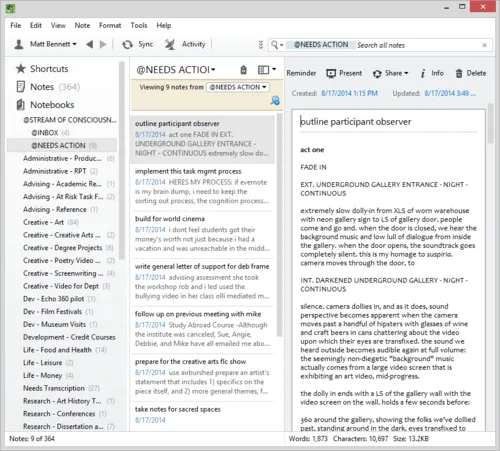
note what differences you see in the earlier version above. these might give you an idea of what kind of shape my notes are in before i decide they’re ready to move out of the creative - writing folder and into @NEEDS ACTION, the evernote folder that serves as my active to-do list.
one purpose of this blog-workshop is to present my working process for students to model, observe, find what works for them, discard what doesn’t. so, i’m working on some of my real screenwriting projects to serve as the content for the blogshop. the text of the note that follows is the actual current, early, state of one of my writing projects, the project whose notes appear in various stages in the screenshots above:
outline participant observer
act one
FADE IN
EXT. UNDERGROUND GALLERY ENTRANCE - NIGHT - CONTINUOUS
extremely slow dolly-in from XLS of worn warehouse with neon gallery sign to LS of gallery door. people come and go and. when the door is closed, we hear the background music and low lull of dialogue from inside the gallery. when the door opens, the soundtrack goes completely silent. this is my homage to suspiria. camera moves through the door, to
INT. DARKENED UNDERGROUND GALLERY - NIGHT - CONTINUOUS
silence. camera dollies in, and as it does, sound perspective becomes apparent when the camera moves past a handful of hipsters with glasses of wine and craft beers in cans chattering about the video upon which their eyes are transfixed. the sound we heard outside becomes audible again at full volume: the seemingly non-diegetic “background” music actually comes from a large video screen that is exhibiting an art video, mid-progress.
the dolly in ends with a LS of the gallery wall with the video screen on the wall. holds a few seconds before:
360 around the gallery, showing the folks we’ve dollied past, standing around in the dark, eyes transfixed to the screen, still softly chatting with one another and sipping drinks. all amongst the audience, too, clumped in various groups: rose, shaw, leannie, marco, marco’s wife, rose’s father, and both rose’s and shaw’s shrinks.
circle back to the screen and slow zoom in until the gallery screen fills the frame.
INT. THE FILM - DAY
a romantic relationship between a man and a woman, made using gondryesque practical effects. very up-like, but breaking just as things are getting sad. not going as far as the death. this is not going to constitute a full first act as it does in up, though. just needs to introduce the characters and their lives. can be made using dolls. very superstar / todd haynes. not sure yet. it has musical accompaniment, which i can play with in terms of its movement in and out of the diegesis.
i would love to have the sound of the film and the film-within-the-film - its music and voiceover - appear only
breaking out of the credits and lengthy intro sequence
IMPORTANT TO CHOOSE APPROPRIATE LOCATION FOR THE INTRODUCTION OF ROSE AND SHAW HERE
rose is is an out of work, 41-year-old mother of a young, 3-year old daughter, eleanor (“leannie”). she’s been divorced for 10 years. seeing a therapist for 10.5. twice a week. heavily medicated.
i’d like rose, in a way, to be the love child of peeping tom’s mark lewis and psycho’s lila crane. but replacing the slasher/horror mode of treatment with existential horror. the horror of realization that you don’t exist.
at parties, she usually drinks until she’s unconscious, early in the evening. he drinks until then sometimes, but the time in the evening at which he passes out is much, much late.
shaw’s a working artist and an elementary school art teacher. he’s great with her daughter. he’s generally nice, maybe a little neurotic, pretty confident and social.
they are two friends in a slightly romantic kind of relationship. both in therapy. this is another commonality. you need to care about them. it needs to feel almost object of my affection without the sap. up to the midpoint of the film, the shower scene. at which point it goes stranger than fiction, with perhaps a small taste of being john malkovich. but made accessible. this is a message film wrapped inside a hollywood film. even better - a touch of michel gondry - eternal sunshine - or even better - be kind rewind. i need a little section of practical effects.
need to introduce both characters, giving them fairly equal visual screen time. however, the film begins clearly from shaw’s point of view, as we will get his voice-over to fully subjectivize him and to push his identification for the audience. the voiceover can even begin in the credits opening of the first act with the mise-en-abyme, film within a film. it would be great if i can shift the sound there between diegetic and non-diegetic
establish the warmth of their relationship, especially with the daughter. this should be written with attention to placement of the characters and, in particular, shaw and rose’s interaction with leannie.
they’re both making breakthroughs in therapy. spend a lot of time together, discus commonalities based on age - cartoons they shared. music they liked.
need to include a scene with rose and her father, and with shaw, possibly, tangentially. is there a 360 here? is this overdoing it? i would like it to be a formal feature though… moments that hint at, or, eventually, reveal rose’s subjectivity and not only her subjectivity but her primacy in the story.
she, she’s been telling him, has been working on the divorce. there is a restraining order on the ex. she’s been in therapy for 10 and a half years but only just been able to talk to her therapist about sex until now
he’s finally started talking to his therapist about real issues.
he picks up leannie from her music lessons
“hello, um, mr. shaw. here to pick up leannie?”
“yes, rose has to work on a group project after class, and she’s stressed out about having her shit…”
catches self, lowers voice
stuff… stuff together before meeting with them, so she’s sticking around campus to prepare.”
a teacher walks into the office with leannie in hand, -who immediately asks, “where’s mommy?”
an unexplained chuckle by someone in the background.
“she’s meeting with people from school after class tonight to work on a project.”
360 at the dinner table with a slow zoom in to rose revealing:
she reveals that she left her ex-husband because of abuse; because he was sexually abusing her. and her daughter. that’s why she’s been in therapy for 10.5 years. she has DID. she loses time. she’s been working steadily for 10.5 years integrating the Others. the alters. her other “personalities,” including a 3-year-old version of herself, a 14 year version of herself, a 20 year old lesbian version of herself who was a college student.
first act break
need psych appointment with shaw and his therapist
media here too, in some way, needs to become a character. the home videos at the end. to set that up, she allows him to videotape her transitioning. as a trade, he asks her videotaping him talking about what he’s been working on in therapy. he reveals sexual abuse as a child, too.
she says, “i know.” inexplicably.
the middle of act two: your shower scene
this is an irreversible act that creates a singularity from which the second half of the film cannot recover. the film must change course entirely in order to recover the path to some kind of resolution.
my shower scene is the 360 camera movement where the audience sees the reveal of the identity of shaw AS rose:
shaw has dinner with a friend, marco, and conversation turns to shaw’s friendship with rose. marco’s leaving town, his wife got a job elsewhere. this is a fact he did not tell marco; he was going to move out of town without telling shaw. the wife, offended by some previous smear, will only peer through curtains as marco hugs shaw and tells him goodbye.
marco
i hate to be mean. but, you’re the only one she sees. rose.
shaw gives a puzzled look for an uncomfortable time.
360° camera editing spin. as the camera spins from OTS of shaw’s pov of marco, to his pov of shaw, the viewer sees for the first time that its rose (real name, eugenie). but the camera spin continues to return to shaw’s pov.
this is me writing like a director. i’m pushing it. this is a primary candidate to go back and look at for elimination in my rewrites. kill your darlings, especially if they are directorial darlings that are intruding when you are trying to build a plot with which to tell your story.
but i think this camera movement and editing technique is really the one to signify the singularity of revealing shaw is just an Other of rose.
what also changes here is perspective. we’ve been encouraged to identify with shaw for the first half of the film. now, we shift to rose’s voiceover and get more of her perspective.
for shaw, this is complete psychological, existential terror - about the loss of subjectivity. a dr. jekyll and mr. hyde – the feeling of giving up control completely.
a scene of rose in therapy. she reveals that the trouble is not entirely with her ex, although the abuse can be true. it caused the Others to re-emerge. but they were there all along, from her childhood through adolescence.
she was abused repeatedly by her father, late into her adulthood. Her ex is not leannie’s father. her father is leannie’s father. this is my homage to chinatown.
act three
it also comes out in therapy that her father is dead.
a flashback to the scene with the father earlier. a 360, this time revealing the father to be rose. just like we saw shaw to be rose earlier.
he loses time and it’s in those moments that rose has been to therapy, working on integration. we see that rose thinks therefore she is. or more accurately, we hear it, as her voice-over takes over. the shift is toward her subjectivization.
shaw comes to realize he is just a personality of rose, who has DID. they have been co-conscious. she’s at the point in her therapy where he needs to be integrated. he will cease to exist as a separate entity, but she will have incorporated him.
this integration needs to have a visual character– she will incorporate an element of his wardrobe.
denouement
last 20 minutes: home movies of rose, leannie, and “shaw,” constructed using practical effects to show their half-imagined nature. how co-consciousness looks on-screen.
eventually shaw disappears from them and its just rose and leannie. until…
rose’s father comes into the room where rose has been mourning, somewhat, the loss of shaw as a separate Other. she’s still wearing whatever article of clothing integrated.
and the implication of the conversation they have is that the father is a personality of hers who needs to be integrated.
have a repetition of dialogue that occurred between rose and shaw when she breaks the news to him that it’s true he’s just an Other. also have her ask him if she can borrow his sweater. she still has on the article of clothing she incorporated from shaw.
———-
notes
shaw and rose are my georges and anne.
the multiple personality scenario must be introduced as a cliche to subvert. that’s the only way this works. it’s overdone. need to re-watch Brian DePalma’s Raising Cain and perhaps Peeping Tom to revisit DID and interesting early use of psychoanalytic theory in the suspense/ grandfather of the slasher.
a little magical realism
it is a loose, loose contemporary retelling of the jataka tale of the man who sacrifices himself for the lioness and her cubs caught in the crevice. i need to find a definitive translation in english of that tale.
———–
and that’s the full entry on the note that’s been brewing for participant observer. if you’re following my reading suggestions as you’re working through this blog/workshop/extracurricular teaching tool, then keep working on tierno, and brande if you haven’t finished her up yet, either. this time around, add to your reading list this link to a free online copy of this brief, classic essay on generating creative ideas:
A Technique for Getting Ideas by James Wood Young,
(this reading was suggested to me a couple of years ago by a good friend and former colleague, andrea rahtz, whom i thank dearly for turning me on to it.)